


On a cold night in January, a man climbs onto the low rail of the bridge at Sag Harbor and stands for a moment looking down at the black water.
He is sixty-seven years old. He lowers himself into the water, and then turns over onto his back.
He begins to swim: slow, deliberate, the backstroke, out past the pilings and toward the open harbor, away from the few lights of the town, looking up at whatever there is to see in a winter sky at that hour.
He is seen from the shore, that night. He does not call out or wave or turn around. He just keeps going, on his back, out, out, out.
If you had been standing there in the cold watching him, he looked like a man going somewhere on purpose.

His name was Ray Johnson, and for most of his life, the art world affectionately referred to him as the most famous unknown artist in New York.
He was born in Detroit in 1927. At seventeen, he arrived at Black Mountain College in North Carolina, which was less a college than a strange and glorious experiment, a few dozen people making art in the mountains with almost no money and almost no rules. He studied color under Josef Albers. He shared those small rooms with John Cage and Merce Cunningham and Willem de Kooning and Buckminster Fuller. He fell in love with the sculptor Richard Lippold. He came out of that place with a head full of chance and collage and the unshakable idea that art did not need a frame, or a gallery, or even a wall, to be real.
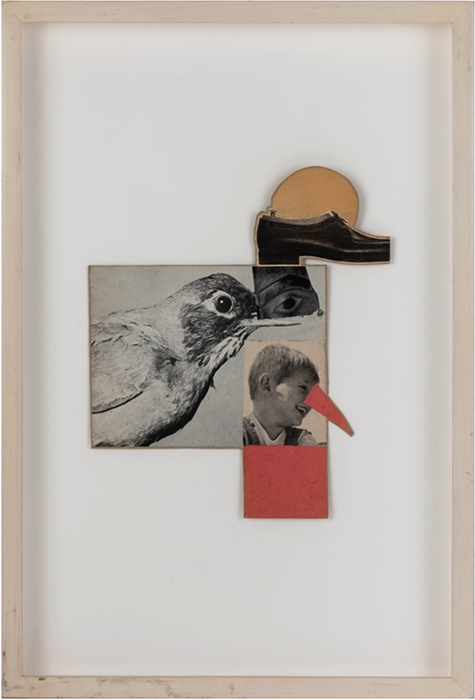
He moved to New York and began making small collages he called moticos, a private word for a private form. He cut them from the things everyone saw and nobody looked at: a Lucky Strike logo, a torn magazine photograph of Elvis or James Dean or Marilyn, a long-eared rabbit he drew again and again until it became his signature.
And then, sometime in the late 1950s, he did the quiet, world-making thing that the rest of his life would grow out of: he put his art in the mail.
Please Add To and Return
By 1962 the poet Ed Plunkett had given the whole endeavor a name, the New York Correspondence School, and Ray, being Ray, liked to spell it Correspondance, a small joke tucked into the title where almost no one would look.
Picture your own mailbox on some ordinary afternoon in the 1960s. Among the bills and the circulars, there is a hand-addressed envelope from a stranger in New York. Inside is a small collage: the long-eared rabbit, a torn scrap of a Lucky Strike pack, a single magazine eye looking back at you. And down in the corner, in his own looping hand, an instruction: add something of your own and send it on to the name below.
Or simply: please add to and return.
The art was not the rabbit. It was what you did next. If you played along, and over the years thousands of people did, the piece began to travel. It gathered other people’s hands and other people’s ideas, moved city to city, came back to him transformed, or never came back at all.
It was not a career. He was not building toward a retrospective. It was a network, a living thing made of stamps and strangers, and it ran for the better part of forty years. If you want the longer, wilder history of the movement he helped invent, I have written it elsewhere.
The short version is that Ray Johnson took the loneliest infrastructure we have, the postal system, the thing that carries our bills and our bad news, and turned it into a way for people to make art together.
A mailed object is special nowadays: someone’s hand touched it. Someone chose the stamp, and folded the paper a particular way, and carried it to the box, and let it go into the dark not knowing exactly when or whether it would reach you. A letter is a small act of faith addressed to the future. Ray understood this decades before the rest of us had a reason to notice what we were losing, and he built an entire art form on it, on the faith that a piece of paper passed from hand to hand could hold people together.
And this is the part that has always undone me a little.
The man who built the most intimate network in American art spent much of his own life alone.
On June 3rd, 1968, the same afternoon Andy Warhol was shot in his studio across town, Ray was mugged at knifepoint on the street.
He decided, that day, that he was done with the city. He left. He moved out to Long Island, first to Glen Cove and then to a house in Locust Valley, and he stayed there for twenty-seven years, mailing his art out into the world and keeping the world itself at a careful arm’s length. The network was his household. He lived alone inside it, the host of a party that happened entirely in other people’s mailboxes.
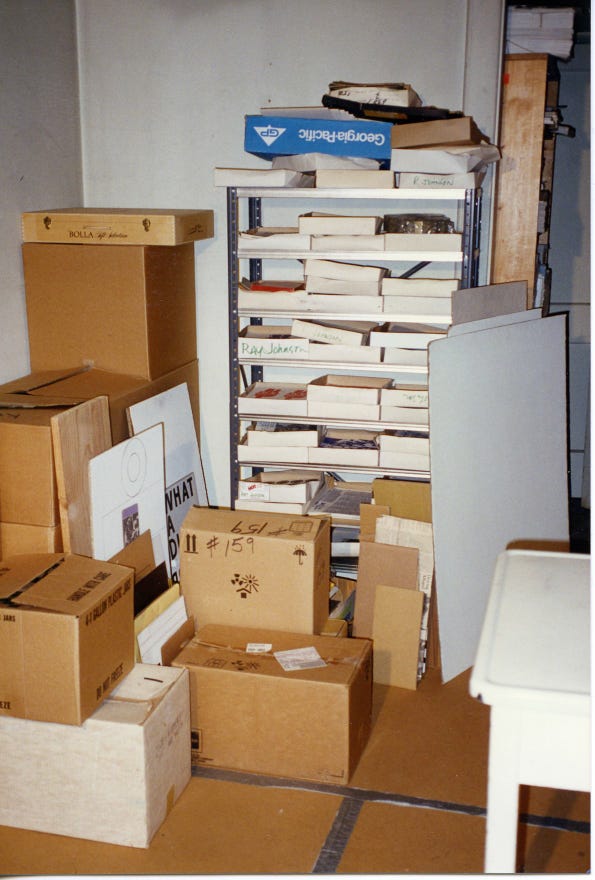
The friendships arrived and left through the slot in his door. He could keep a thousand people close on paper and let almost none of them into the room. The people who wrote to him for years often never once saw the inside of that house, where he sat among his collages, cutting and arranging and rearranging, sending the closeness out and rarely letting it come all the way back in.
The Last Day
On January 13th, 1995, Ray Johnson checked into a motel. The room number was 247.
It is the kind of detail you almost wish you hadn’t noticed, but it is there: the date was the thirteenth. His age was sixty-seven, and six and seven make thirteen. The room was two-four-seven, and two and four and seven make thirteen. A man who had spent forty years hiding small patterns and jokes inside his work appears to have left one last one, and then declined, permanently, to explain it.
Back at the house in Locust Valley, people would later find hundreds of his collages, arranged with care. Nothing frantic, nothing torn apart. Everything in its place, the way you tidy a room before you go on a vacation.
Friends would say, afterward, that in his final weeks he had told them he was working on his greatest piece. Whether that was true, or one of his lifelong misdirections, or simply something the people who loved him needed to believe so the cold water would mean something, no one can honestly say.
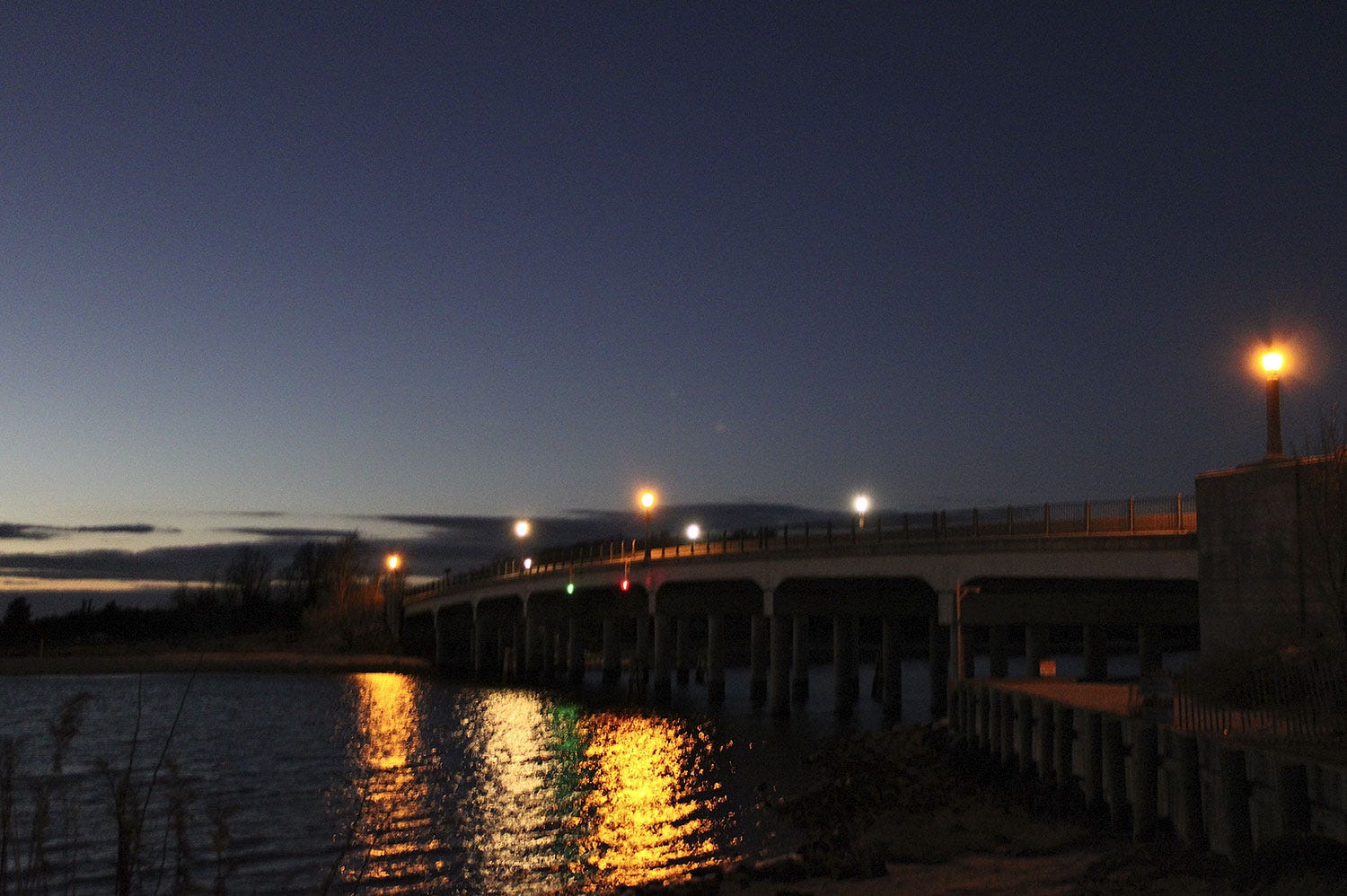
And then the bridge, and the January dark, and the slow backstroke out.
I am not going to tell you what it meant. I don’t know. The people who knew him best have never agreed, and Ray spent his entire life refusing to resolve into any single, tidy thing. Despair, or a last deliberate composition, or both of those at once, wound together. The harbor keeps that secret, and I think he wanted it kept.
Here was a man who spent his whole life sending pieces of himself out into the world, each one addressed to another person, each one carrying a small note that said, in effect, add something, pass it on, return it to me. And at the very end, alone on his back in the dark water, he seems to have done that one more time, with the only piece he had left.
He mailed himself out. Addressed to everyone and to no one. Please add to and return.
In the years since that January, the people he once mailed to have kept his work moving. They mounted the exhibitions he would never sit still for, made a film about him with the perfect title, How to Draw a Bunny, and kept his rabbit multiplying across the world. He asked, thousands of times, to be added to and returned, and we have never quite stopped doing it.
Some pieces go out into the dark addressed to no one we can name, and they do not come back. All we can do is let them go, and add something of our own, and try to keep the chain moving anyway.
Your friend and fellow letter lover,
K. Larkin 💌
Where exactly is Ray’s story leading me? I keep wondering, following a trails of questions (1) how could a man survive in New York, and now in the end of the essay the motel room - this thirteenth day… room 247… the trail keeps bending in directions I didn’t expect. I’m a little lost, honestly — but you’ve got my full attention.
hoo... dark, sad, touching, real. Well done!